Unplug to Level Up: Why Music Parents Are Ditching Digital Rhythm Tools for Old-School Clapping Games
Here's a plot twist nobody saw coming: the people who probably know the most about rhythm games and digital music tools are increasingly choosing not to use them with their kids.
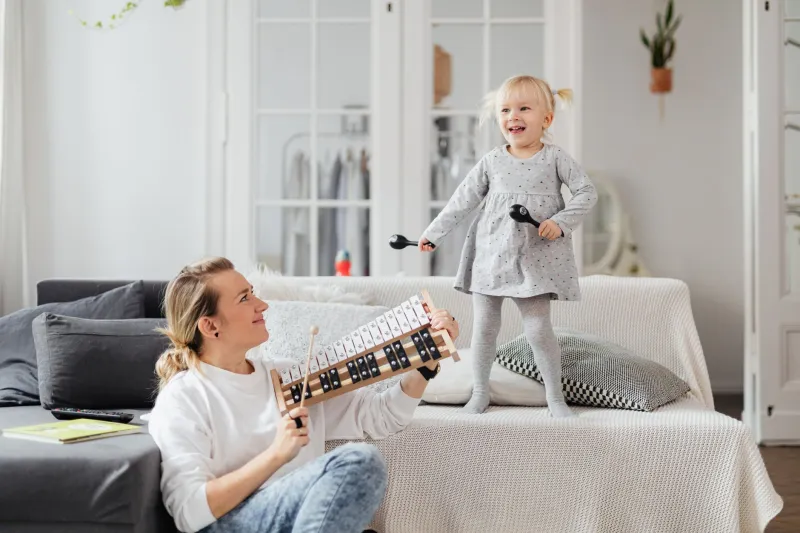
Talk to enough working musicians — the kind who gig on weekends, produce tracks in home studios, and yes, spend time on platforms like this one — and a quiet countertrend starts to emerge. When it comes to their own children's musical development, a lot of them are going decidedly low-tech. We're talking hand claps, body percussion, call-and-response games, and living room drum circles. No screens. No point systems. No streaks.
So what do they know that the rest of us don't?
The Problem With Points
Rhythm games are genuinely great at a lot of things. They're engaging, they're accessible, and they lower the barrier to entry for people who might otherwise feel intimidated by music. But some music educators and professional players are starting to ask a harder question: what happens when the game goes away?
The concern isn't that rhythm games are bad. It's that the feedback loop they create — tap the right beat, earn a reward — might be training kids to respond to the game's rhythm rather than developing an internal sense of pulse. The metronome, the visual cue, the chiming success sound: those become the scaffolding. And scaffolding, if it never comes down, stops being a tool and starts being a crutch.
One session guitarist and dad of three put it plainly in an online forum thread that's been making the rounds in music teacher circles: "My kids got really good at the app. Then I sat them down with a drum and asked them to keep a beat while I played guitar. Total deer-in-headlights moment. The app never taught them to listen."
That word — listen — comes up over and over in these conversations.
What Call-and-Response Actually Teaches
Long before anyone invented a music app, cultures around the world were teaching rhythm through call-and-response. A leader claps a pattern. The group echoes it back. Simple, right? But the cognitive work happening underneath that simplicity is anything but.
To echo a rhythm accurately, you have to hold it in your head while someone else is making sound. You have to predict where the next beat lands before you hear it. You have to stay connected to another person's tempo in real time — not a pre-programmed sequence, but a living, breathing human who might speed up slightly when they get excited or slow down when they lose focus.
That's a fundamentally different skill set than hitting a button when a prompt appears on screen.
Body percussion traditions — stomping, clapping, patting, snapping in layered combinations — add another dimension entirely. When kids learn to generate rhythm from their own bodies, they start to understand that music isn't something that comes at you from a speaker. It's something that lives inside you, waiting to come out.
The Gamification Dependency Debate
To be fair, not everyone in the music education world is sounding alarms. Plenty of teachers and researchers point out that gamification has genuinely brought rhythm practice to kids who might never have touched an instrument otherwise. Engagement matters. Motivation matters. If an app gets a reluctant eight-year-old excited about keeping a beat, that's a real win.
The debate isn't really about whether digital tools have value. It's about sequencing — about when you introduce them and what role they play in the larger picture.
Some music teachers are experimenting with a hybrid approach that's gaining traction in progressive music education circles: start analog, add digital later. Spend the first few months of a child's musical life doing purely physical, social rhythm work — games, clapping circles, simple percussion with found objects. Build the internal pulse first. Then introduce apps and rhythm games as a way to extend and challenge that already-established foundation.
The idea is that the technology works best when it's enhancing something that's already there, not trying to install it from scratch.
Where Platforms Like This One Fit In
Here's the honest truth from where we sit at Clapping Music: we believe in what collaborative digital music tools can do. We've seen people find their groove, build real friendships, and unlock musical confidence they never knew they had — all through screen-based rhythm play. That's not nothing. That's actually kind of everything.
But we also think the most interesting version of this conversation isn't "apps vs. unplugged." It's about building a musical life that's rich enough to include both.
The parents and educators pushing back against full digital immersion aren't anti-technology. Most of them use rhythm apps themselves. What they're really advocating for is intentionality — making sure that the foundation of a young musician's relationship with rhythm is rooted in something physical, social, and human before it gets filtered through a screen.
And honestly? That philosophy maps pretty well onto what the best collaborative music platforms are trying to do anyway. The whole point of playing together online isn't to replace human connection — it's to extend it. To let you jam with someone in Seattle when you're sitting in Nashville. To let a kid in rural Kansas find a clapping partner in Chicago.
The Takeaway for Musical Families
If you've got kids and you're thinking about their musical development, the professional musicians quietly leading this "metronome rebellion" would probably tell you this: don't start with the app. Start with your hands.
Clap rhythms at the dinner table. Play echo games in the car. Bang on pots. Let them feel what it's like to lock into a groove with another person before they ever experience what it's like to lock into a groove with a screen.
Then, once that internal pulse has had time to take root, go ahead and open the app. Let them explore, compete, create, and collaborate in the digital space — because that world has real things to offer.
The goal isn't to choose between old-school and new-school. It's to make sure the old-school stuff lays a foundation strong enough that the new-school stuff can actually build on it.
Rhythm is, at its core, a conversation between people. The best tools — digital or otherwise — are the ones that keep that conversation alive.