Ditch the Algorithm: Why Musicians Are Craving Real Human Rhythm Again
For a hot minute, it seemed like music apps had solved everything. Want to improve your timing? There's a metronome app for that. Want to practice scales at 2 a.m. without waking your roommates? Download something, plug in your earbuds, done. The solo practice pipeline felt airtight.
Except it wasn't.
Something kept nagging at musicians across the country—from weekend guitarists in Austin to self-taught drummers in Cleveland—and that something had a name: loneliness. Not the dramatic, movie-score kind, but the low-grade, creeping sense that playing music by yourself, even with a sophisticated app cheering you on, was missing the whole point.
Now, a genuine cultural shift is underway. Musicians are ditching the solitary grind and actively seeking out real-time, human-to-human playing experiences. Whether it's through platforms that sync players across time zones or old-fashioned in-person jam nights making a serious comeback, the message is loud and on beat: people want to play with people again.
The App Ceiling Nobody Talks About
Here's the thing about practicing alone with an app: you can get really, really good at playing alone with an app. Your timing tightens. Your muscle memory sharpens. You nail the exercises. And then you jump into a session with actual humans and suddenly feel like you've never held your instrument before.
Music coaches across the US have started calling this the "app ceiling"—the invisible plateau where solo digital practice stops translating into real-world musical fluency.
"I see it constantly with my students," says one Nashville-based guitar instructor who teaches both in-person and online. "They come in with technically clean playing, but the moment someone else is in the room making sound, they freeze up or lose the pocket entirely. Apps can teach you about rhythm. Only people can teach you how to hold rhythm with someone else."
The distinction matters more than it sounds. Playing with another person means reading micro-cues—the slight lean into a downbeat, the breath before a fill, the way a groove subtly accelerates when the energy in a room lifts. None of that lives inside a tap-tempo button.
What Your Brain Actually Wants
Neuroscience backs up what musicians are feeling in their gut. Research into social music-making consistently shows that the brain responds to collaborative rhythm in ways that solo practice simply cannot trigger.
When two people synchronize rhythmically, their brains begin to mirror each other's neural firing patterns—a phenomenon sometimes called "neural coupling." The reward circuits light up differently than they do during solitary play. Dopamine releases are stronger. The sense of accomplishment is deeper. Basically, your brain treats playing in sync with another human as a fundamentally different—and significantly more satisfying—experience than nailing the same pattern alone.
"There's a reason we evolved to make music together," explains a cognitive neuroscientist who studies auditory processing and social bonding. "Rhythm is one of the oldest tools humans used to coordinate group behavior. When you play in sync with someone else, you're activating ancient social reward pathways. An app can simulate the task, but it can't simulate the relationship."
That relationship piece is exactly what platforms like Clapping Music are built around. The whole premise—play together, create together, groove together—isn't just a tagline. It's a direct response to what the science and the street-level musician experience are both pointing toward.
Accountability You Can't Fake
Ask anyone who's tried to build a solo practice habit how sustainable it is. Most will laugh. The accountability structures that keep musicians showing up consistently aren't internal—they're social.
When you've got a jam partner waiting on the other end of a session, you show up. When a rhythm game leaderboard is tied to a community of real players you've been trading riffs with for weeks, you practice harder. When you know someone's going to hear your timing wobble in real time, you focus in ways that no personal best score on a solo app can motivate.
This is the accountability loop that collaborative platforms create naturally, and it's something musicians are increasingly naming as the reason they've made the switch.
"I used to practice maybe three times a week on my own," says a 34-year-old bassist from Chicago who started using a real-time collaborative music platform earlier this year. "Now I'm on almost every day because there are people I actually play with. Missing a session feels like standing someone up. That social pressure is exactly what I needed."
The Jam Night Renaissance
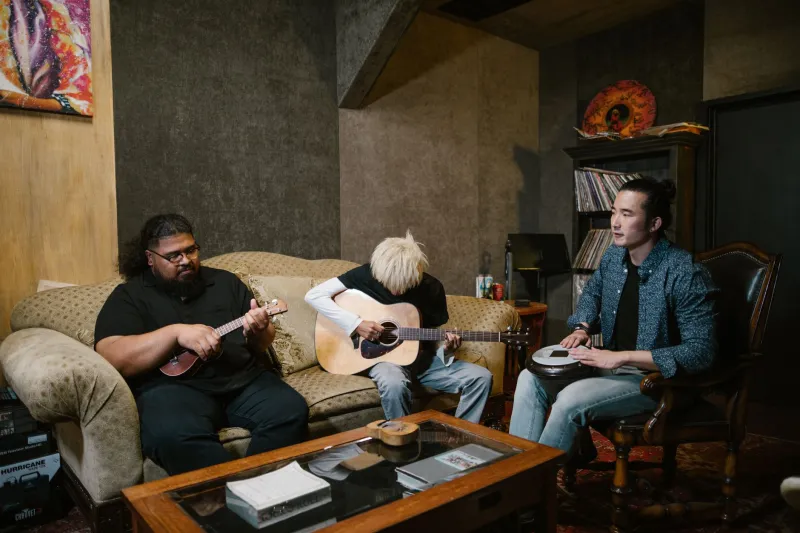
It's not just happening online, either. Across the country, in-person jam nights are seeing a genuine resurgence. Local music stores that added open jam sessions to their calendars post-pandemic are reporting consistent, growing turnouts. Community centers are hosting rhythm circles. Even corporate team-building events are increasingly swapping trust falls for drum circles.
The throughline is the same whether it's a Tuesday night at a music shop in Denver or a synchronized online clapping game with players from Portland to Miami: people are hungry for the specific electricity that only comes from making rhythm with someone.
"There's a moment in every good jam," says one music educator who runs community rhythm workshops, "where you stop thinking about what you're doing and just lock in with the people around you. That moment is the whole reason anyone picks up an instrument. You can't manufacture it solo. You have to show up for it together."
What This Means for How We Think About Practice
The metronome—that faithful, ticking taskmaster—isn't going anywhere. Neither are solo practice apps. They serve a real purpose, especially in the early stages of learning. But the cultural conversation around musical growth is evolving.
More musicians, coaches, and researchers are pushing back against the idea that practice is primarily a private activity. The most meaningful musical development, they argue, happens in the friction and flow of real-time human interaction—in the split-second adjustments you make when someone else's rhythm pushes against yours, in the surprise of a groove that goes somewhere you didn't expect, in the laughter when everything falls apart and you have to find the beat together again.
Platforms that center that experience—that put the collaborative, social, human element at the core of how music gets made and learned—aren't just offering a feature. They're offering a fundamentally different philosophy of what music is for.
And increasingly, millions of musicians are voting with their time, logging off from the solo grind and logging into something that sounds, feels, and grooves a whole lot more like the real thing.
The algorithm never had a chance.