From Two Left Hands to Two Confident Ones: How Clapping Games Are Unlocking the Musician in Everyone
The Lie We've All Been Told
Somewhere between a third-grade recorder lesson and watching a YouTube guitarist shred through a solo, a lot of us quietly decided we just weren't music people. Maybe a teacher said something offhand. Maybe you tried to learn piano and gave up after two weeks. Maybe you just never felt the spark. Whatever the story, the conclusion was the same: music is for other people.
But here's the thing — that conclusion might be completely wrong. And a growing wave of players in the Clapping Music community are proving it, one rhythmic handclap at a time.
Percussion-based rhythm games — the kind that ask you to clap, tap, stomp, or slap in time with a pattern — are doing something quietly revolutionary. They're handing musical confidence back to the people who thought they'd lost it forever. Or never had it to begin with.
Why Clapping Hits Different
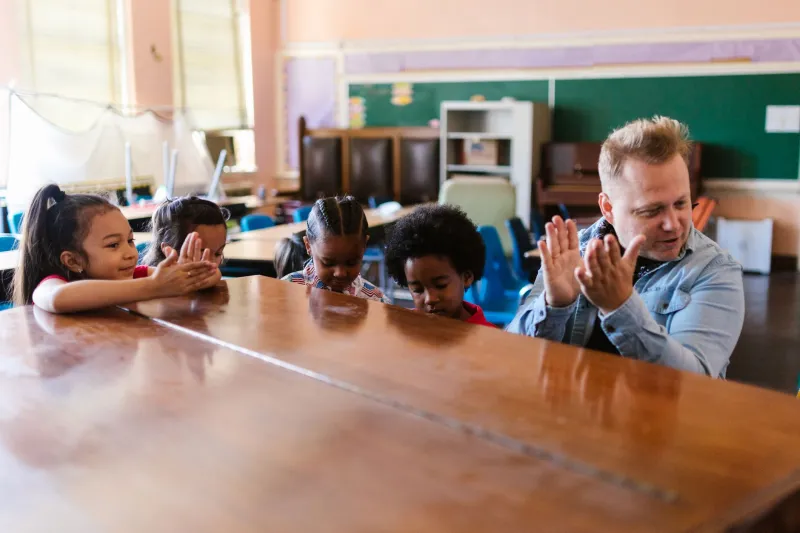
There's a reason babies clap before they do anything else musical. Clapping is the most primal form of rhythm-making we have. No equipment required. No years of practice. No music theory. Just your two hands and a beat.
When you pick up a guitar, there's an immediate wall between you and the music — frets, chord shapes, finger calluses, tuning. The instrument itself becomes a barrier. But when you clap? The feedback is instant, physical, and deeply satisfying. You feel it in your palms. You hear it in the room. You are the instrument.
That immediacy matters more than most people realize from a psychological standpoint. Dr. Jessica Grahn, a cognitive neuroscientist who studies rhythm and the brain, has noted that rhythmic synchronization — matching your movements to a beat — activates reward centers in the brain almost immediately. You don't have to be skilled to feel good doing it. You just have to participate.
Percussion-based games are essentially designed around that exact feedback loop. Hit the beat right, and your brain lights up. Miss it, and you try again — without the crushing weight of "I'm ruining a $600 instrument."
Real People, Real Breakthroughs
Take Marcus, a 34-year-old accountant from Columbus, Ohio, who describes himself as someone who "couldn't carry a tune in a bucket." He started playing rhythm games on Clapping Music mostly because his teenage daughter was into it and he wanted something they could do together.
"I figured I'd be terrible and she'd laugh at me," he says. "And I was terrible at first. But it didn't feel embarrassing the way I thought it would. It just felt like a puzzle I wanted to solve."
Within a few weeks, Marcus was holding his own in collaborative sessions with strangers online. Six months later, he joined a community drum circle hosted through the platform. He now owns a hand drum and is learning basic djembe patterns.
"I genuinely thought I had no rhythm," he says. "Turns out I just needed a way in that didn't make me feel stupid."
Marcus's story isn't unusual in the Clapping Music community. Again and again, players describe the same arc: skepticism, low-stakes entry, small wins, growing confidence, and eventually — curiosity about what else they might be capable of.
The Psychology of the Low-Stakes Entry Point
So what exactly is happening in the brain when a self-described non-musician starts clapping along to a rhythm game and actually succeeds?
A big part of it comes down to something psychologists call self-efficacy — your belief in your own ability to accomplish a task. People who identify as "unmusical" typically have very low musical self-efficacy. They expect to fail before they even start, which creates a self-fulfilling prophecy.
Percussion-based games disrupt that cycle in a specific way: they reframe the challenge. Instead of asking "can you play music?" — a question loaded with years of baggage — they ask "can you clap when you see this pattern?" That's a much smaller, much more answerable question. And when the answer turns out to be yes, it chips away at the bigger, scarier belief.
It's also worth noting that clapping games are inherently social in a way that learning an instrument alone in your bedroom is not. Community performance and collaborative play — both central to what Clapping Music is built around — create what researchers call social proof. Watching someone else who also said they had no rhythm absolutely nail a tricky pattern is a powerful motivator. If they can do it, maybe you can too.
From the Clap to the Full Composition
What's fascinating is where this confidence tends to go once it takes root. The Clapping Music platform isn't just a place to tap along to beats — it's a full ecosystem for collaborative music-making. And a significant number of users who entered through percussion-based games have migrated into other areas of the platform: beat-making tools, collaborative songwriting sessions, even live virtual performances.
The clap, it turns out, is often just the door.
For Priya, a 28-year-old teacher from Atlanta who grew up in a household that never had instruments, the journey from rhythm game player to active collaborator happened almost without her noticing. "I was just playing for fun," she says. "Then someone in a session asked if I wanted to layer a melody over the beat I'd built. I said I didn't know how. They said they'd show me. And then suddenly I was making actual music with a stranger on the internet."
She's now a regular in the Clapping Music community sessions, co-creating pieces with musicians across the country. "I still don't think of myself as a musician, exactly," she admits. "But I make music. So maybe I need to update my definition."
The Bigger Picture
There's something almost political about what percussion-based rhythm games are doing. For decades, music education in the US has been gatekept by access — access to instruments, to lessons, to schools that still fund their arts programs. A lot of people who grew up without those things internalized their exclusion as personal failure. I'm just not musical. When really, the door was never opened for them.
Clapping games open the door. They do it with nothing more than the body you already have and a beat that your nervous system was literally built to respond to.
When Marcus claps along with his daughter, when Priya layers a melody over a beat she built herself, when thousands of players across the country discover that their hands already knew something their minds hadn't caught up to yet — that's not just entertainment. That's music reclaiming people it was always supposed to include.
You don't need a piano. You don't need lessons. You just need to start clapping.